
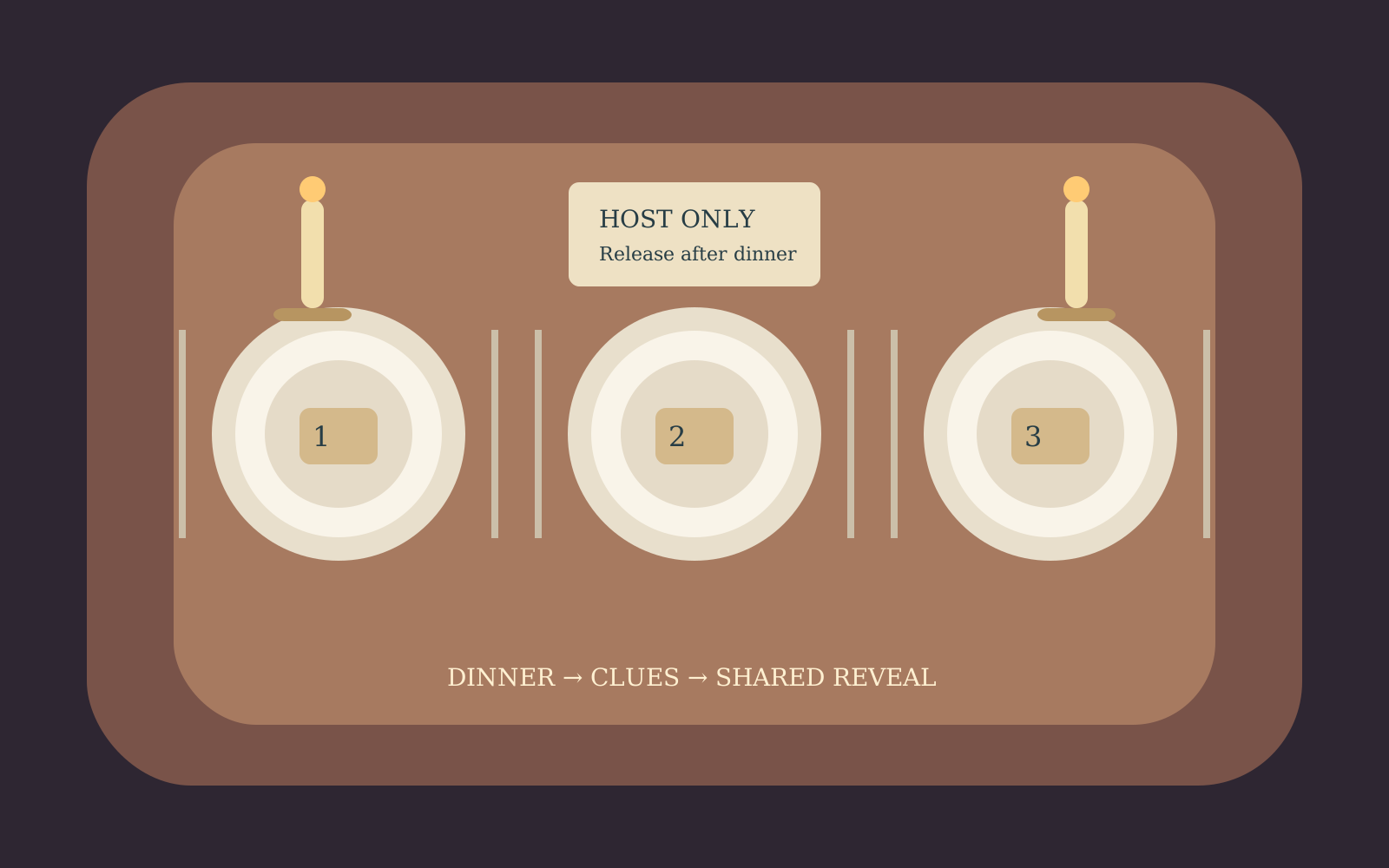
Write the explanation before the reveal
MysteryTable organizes a host-authored mystery into roles, public evidence, release minutes, discussion and a solution. It is useful when you already have a premise and need to see whether the people and information can be introduced coherently. The tool does not generate a fully tested mystery from a one-line theme.
Choose a fictional, age-appropriate situation and decide what really happened. Work backward from that explanation to evidence guests can examine. A satisfying solution should account for the available clues without introducing a decisive fact only during the reveal. The host must check this reasoning; the planner validates fields, not the truth of a story.
Enter the cast and clue material
Set common event details, then place story stages or clues on separate lines. Enter unique participants and exactly one unique story role per participant. Role assignment follows input order. The solution actor must match an entered role or participant, and the solution explanation is text you provide.
For Release minutes, use Auto or comma-separated numbers within the event duration. There must be one ordered minute value per clue. These are offsets from the start, not clock-time fields. Public evidence attached to role records cycles through the clue lines; it is not a distinct private secret system. Use SecretSigil for a separately managed private-role draw.
Control what guests see and when
Automatic clue times use floor((clue number × duration) ÷ (clue count + 2)). The general five-phase outline is a separate view, with a theme introduction and a final solution reveal. Reconcile both before hosting rather than assuming every clue fits naturally into its neighboring phase.
The browser displays the complete host result, including solution information. It does not dispatch clues at the entered minutes or keep player-specific secrets behind logins. Print or prepare participant material deliberately. The vote controls record host-verified counts for role names; they do not decide whether the most popular accusation is correct or alter the entered solution.
Fictional example: an atlas moved out of damp
For a 120-minute library supper beginning at 18:00, enter six total guests and four players: Ari, Bea, Cleo and Dev. Use roles Reader, Courier, Curator and Keeper. Enter three clues: A dated cabinet log authorizes moving the atlas; A shelf card directs readers to the dry cabinet; A signed receipt records the curator’s transfer. Set the solution actor to Curator and explain that the move was authorized to keep the atlas dry.
With Auto, clue offsets are 24, 48 and 72 minutes. The five outline blocks are twenty-four minutes, ending at 20:00. The four roles follow the four player names in order; the fourth role’s public evidence repeats the first clue because the evidence list has three entries. The host checks that every group can access all essential evidence rather than depending on one player to improvise a confession.
In rehearsal, the host reads the three documents and asks whether the solution follows without an unstated fact. Guests can vote on their interpretation, then compare it with the signed evidence. These are fictional documents for a planning example, not real archival records or a report of wrongdoing.
Prepare for disagreement without improvising unfairly
Write the host’s answer explanation and decide how hints will be offered. If guests propose another explanation that fits every clue, consider revising the story before the event. During play, clarify wording rather than inventing new evidence to force the intended answer.
Keep the topic comfortable for the group and allow observers, breaks and nonperforming roles. Do not use real people as suspects or ask participants to disclose private experiences. Save a host copy and keep the solution out of shared screenshots, full exports and communal printouts. The planner supports a fair conversation only when the real host manages disclosure carefully.
Questions before you begin
Does the tool check whether the clues prove my solution?
No. It checks field relationships and timing format. You must test the evidence and ensure the conclusion is supported.
Are clue releases automatic on guest devices?
No. Release minutes are a host schedule. There is no timed delivery service or authenticated participant portal.
Can the most-voted role become the solution?
The tally does not rewrite the answer. It records opinions; the solution actor and explanation remain the values you entered.
Why did one role receive the same evidence as another?
Public evidence cycles through the clue list. With more roles than clues, a clue repeats. Plan shared access to essential evidence deliberately.