
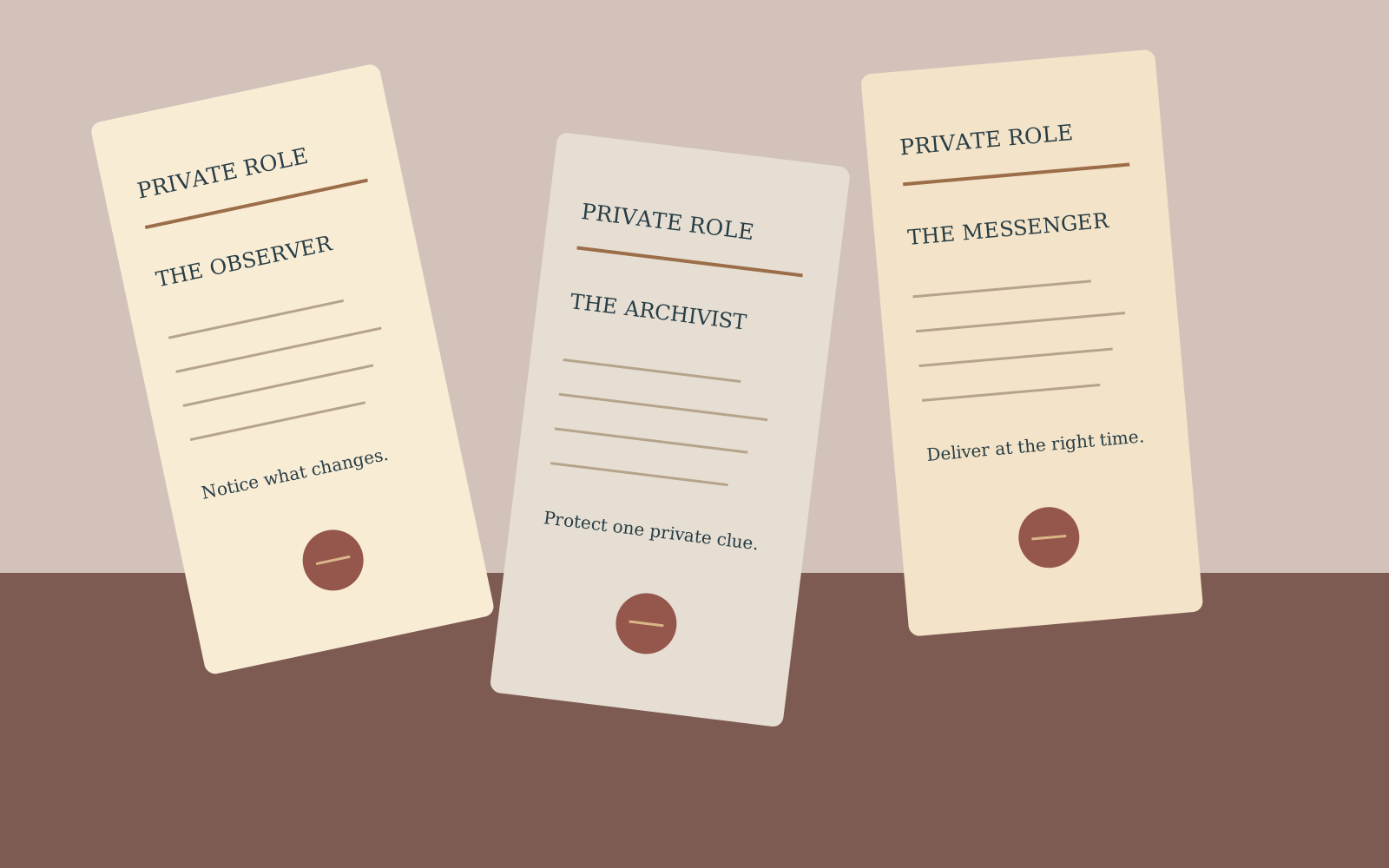
Separate the participant from the character
SecretSigil makes private role cards for a fictional gathering. Each card combines a participant name, randomly assigned role, shared premise, secret and a simple story relationship. Use it when everyone needs exactly one distinct role and the host wants a draw without accidentally separating a character from their information.
The tool does not write a complete mystery or verify relationships against a story canon. Its generated letter connections are conversation prompts, not evidence that real messages were sent. Decide which parts of the story are public, which are private and when participants may disclose them before distributing the cards.
Match counts before creating the draw
Enter the shared fictional premise and unique participant names. Provide one unique role per person. Both lists reject case-insensitive duplicates, and the cast is limited to one hundred participants. Optional secrets must either be entirely blank or contain one nonempty line per role in the same original order.
Original role setting offers Archive, Manor, Guild or Expedition. Use Generate original role slots to fill the role box from that setting, then review or edit the labels. Changing the setting is not a promise that Create my plan rewrites manually entered characters. The helper supplies role slots, not a custom secret or a complete character biography for each person.
What random assignment preserves
Roles are shuffled before being matched to the participant list. Custom secrets are looked up using the role’s position in the original role list, so they travel with the character rather than the participant’s row. If secrets are blank, the tool supplies a numbered archive-fragment secret tied to the original role position.
The relationship text connects each participant to the next name in the list, returning from the last to the first. It is not a randomized relationship graph or a deduction about who should know whom. Review it for your story. Regenerating can produce another role draw; it does not preserve an earlier public allocation unless you save and reopen that result.
Fictional example: four keepers of a festival plan
Enter Ari, Bea, Cleo and Dev as participants. Use Map keeper, Lantern maker, Messenger and Archivist as roles, with these secrets in matching order: The map marks the approved entrance; The lantern uses a paper light effect; The messenger carries the revised time; The archivist holds the signed final plan. The shared premise is that the festival programme has been revised.
After creation, any participant may receive Map keeper, but that card must contain the entrance secret. The Messenger must retain the revised-time secret. You cannot predict a particular person’s role before the shuffle; inspect the cards instead of publishing a presumed assignment.
Relationships run Ari → Bea → Cleo → Dev → Ari regardless of which roles were drawn. The host may use those links as optional introduction prompts. Check all four cards, save the selected draw and use Print only this card for the intended participant. A rehearsal with one card confirms what will actually appear in the browser print preview.
Private display is not secure storage
The result is explicitly a host view. A collapsed card hides text visually but does not authenticate its reader. Someone with the same browser profile, a full export or the host screen may see all secrets. Do not present this as encrypted messaging or a secure role-delivery service.
Keep printed cards and PDF destinations separate, avoid communal screens and collect spare sheets. Real contact details or sensitive personal information are unnecessary for a fictional secret. If a guest does not want a private role, agree a different participation route before the draw. Maintain a backup of the approved host version while protecting it from people who should receive only one card.
Questions before you begin
What if I have more participants than roles?
Creation is refused. Provide exactly one distinct role per participant; use the role-slot helper if you need a starting list.
Can I write secrets for only some roles?
Not in the current line-based format. Supply one per role or leave the entire secrets field blank. Blank lines are not reserved slots.
Will a secret stay with its character after shuffling?
Yes. Custom secrets are matched to the original role positions, then carried with the shuffled roles. Verify the final cards before distributing them.
Can I send the full backup to all players?
A complete backup may expose every card and secret. Prepare participant-specific material instead and review the print preview before sharing.